

Printing a ridged vase with the 3D Print Vase Generator
Difficulty: easy. Time: 5 minutes to design, 2-6 hours to print depending on height. Method: 3D printing only.
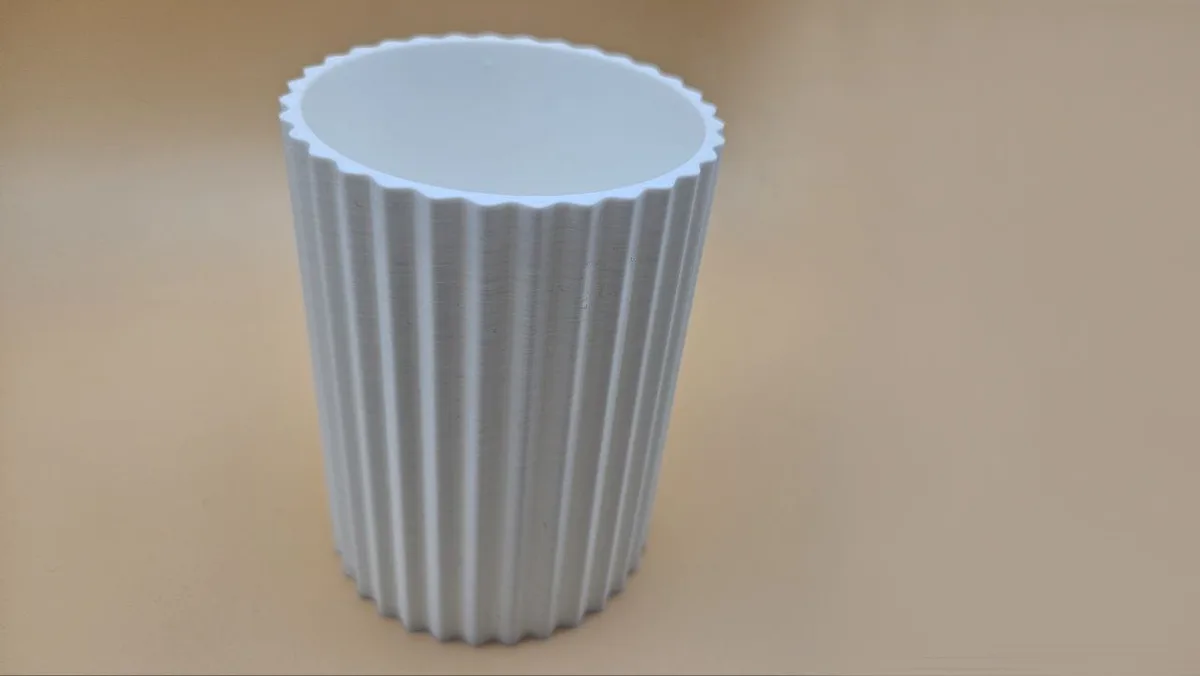
Printed vases are one of the most satisfying decor projects there is: tall, sculptural, and surprisingly fast when printed in spiral mode. This generator handles the geometry so you can play with the surface. Three sliders, ridge count, ridge depth, and ridge rotation, take you from a clean smooth cylinder to deep flutes to a dramatic twisted helix.
Because you control inner diameter and wall thickness directly, it doubles as a planter generator: size the cavity to a nursery pot and the plant drops straight in.
What You'll Need
- Any FDM 3D printer; check your max Z height against the vase height
- PLA for decorative vases; PETG if it will hold a watered planter pot
- Silk or multi-color gradient filament, which looks spectacular on ridged surfaces
- A glass or test tube insert if you want it to hold water with fresh flowers
Step 1 - Set the body
Open the tool and set Inner Diameter, Height, and Wall Thickness. For a flower vase, 60-80 mm inner diameter and 150-200 mm height is a graceful proportion. For a planter, measure the nursery pot just below its rim and add 2-3 mm. Keep wall thickness around 2-3 mm; the ridges add stiffness on top of that.
Step 2 - Sculpt the ridges
- Ridge Count sets how many flutes wrap the circumference. Few ridges (8-12) read bold and architectural; many ridges (30+) read as fine pleats.
- Ridge Depth controls how far they protrude. Shallow ridges catch light subtly; deep ridges throw real shadows.
- Ridge Rotation twists the ridges around the body as they rise. Zero gives vertical flutes like a classical column; crank it for a spiral barber-pole twist.
- Watch the live 3D preview as you adjust; the right combination is obvious the moment you see it.
Step 3 - Export
Download STL or 3MF and take it to your slicer.
Choose Your Build Method
Slice and print
- For a decorative vase, try spiral/vase mode in your slicer with a 0.6-0.8 mm single wall; it prints fast, silent, and seam-free. Note that vase mode replaces the generated wall thickness with a single extrusion.
- For a watertight or load-bearing planter, print normally with 3-4 perimeters and 0.2 mm layers instead, keeping the generated wall thickness.
- Silk and gradient filaments shine here: the ridges turn color shifts into vertical light streaks.
- Slow outer wall speed slightly (around 40 mm/s) on deep-ridge designs so corners of the flutes stay crisp.
- PLA vases holding water need a glass insert or an epoxy-coated interior; PLA alone weeps slowly through layer lines.
Make It Yours
- Print a graduated set of three (same ridge settings, heights 120/160/200 mm) for a mantel arrangement.
- Zero rotation plus 12 deep ridges makes a clean Doric-column pencil cup at desk scale.
- Maximum twist with fine ridges in silk gold looks like spun metal.
- Size one as a cache pot for a standard 4 inch nursery pot and skip drilling drainage entirely.
- Short and wide (120 mm diameter, 80 mm tall) becomes a gorgeous ridged fruit bowl or key dish.
- Print matched vases in your wedding colors as centerpiece bases.
- Pair a smooth low cylinder with a heavily twisted tall one in the same filament for a deliberate two-piece set.
New free tools, every month.
New laser cutting tools, what's coming next, and features we're building right now. Only MyLaserTools.com news. No spam, ever.
© 2026 MyLaserTools.com. All rights reserved.